



Grid for React
React version of this topic (compatible with React 19+). Keep the same configuration logic from JavaScript and pass it as component props.
What this topic covers: practical setup, the framework-specific API access pattern, and copy-adapt guidance for the examples in this page.
import React, { useMemo, useRef } from 'react';
import { Grid } from 'smart-webcomponents-react/grid';
import 'smart-webcomponents-react/source/styles/smart.default.css';

export default function App() {
  const componentRef = useRef(null);
  const componentProps = useMemo(() => ({
    // Copy this topic's JavaScript configuration here.
  }), []);

  return <Grid ref={componentRef} {...componentProps}></Grid>;
}
Use componentRef.current for API methods in this topic.
The Grid's header and footer options allow you to add your own components to the grid's header and footer.
Grid Footer
To turn on the Grid's footer, you can use thefooter property.
The code sample below shows how to show a footer and apply a custom rendering to it.
footer: {
	visible: true,
	template: (element) => {
		element.innerHTML = `<div style="display: flex; height: 100%;">
			<smart-button>Save</smart-button>
		</div>`
	}
}
Another way is to use HTMLTemplateElement. For example:
<template id="footerTemplate">
	<div>
		<smart-button>
			Click Me
		</smart-button>
	</div>
</template>
and the footer property will look like that:
footer: {
	visible: true,
	template: '#footerTemplate'
}
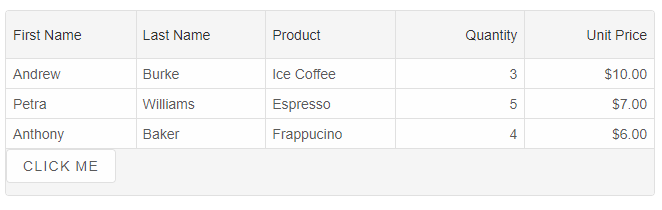
Grid Header
Similarly to the footer, the header is enabled by using theheader property.
header: {
	visible: true,
	template: '#headerTemplate'
}
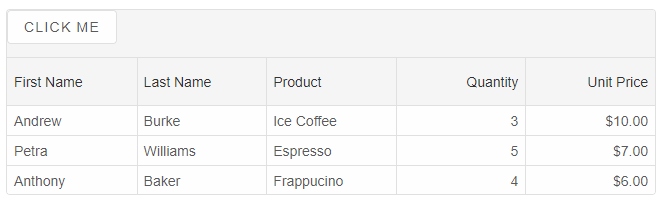
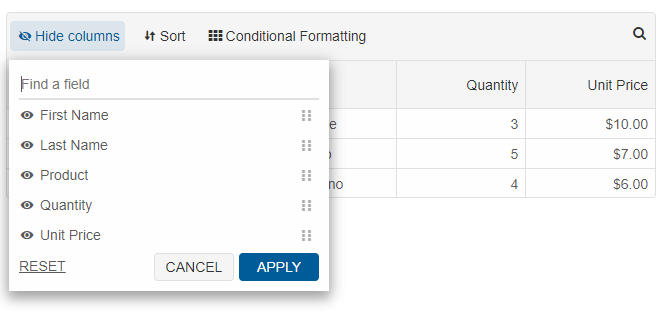
The Grid has built-in header template, so if you do not set the
template property, the default haeder template will be displayed with options to sort, filter, group, search and customize columns.
The header.buttons property determines which buttons in the header will be displayed. The list with buttons is ['columns', 'filter', 'group', 'sort', 'format', 'search'].
For AI tooling
Developer Quick Reference
Topic: grid-header-and-footer Component: Grid Framework: React
Main methods: (none detected)
Common config keys: footer, header
Implementation Notes
Compatibility: React 19+ API access pattern: const componentRef = useRef(null) + componentRef.current.method()
Lifecycle guidance: Use useMemo for large config objects and call imperative API through componentRef.current after first render.
Common pitfalls:
- Recreating columns/dataSource objects on every render can reset component state.
- Calling API methods before ref is available causes runtime errors.
- Mixing controlled and imperative updates without sync can lead to stale UI.
Validation checklist:
- Keep config objects memoized when possible.
- Guard API calls with ref existence checks.
- Verify CSS theme import is present once per app.