



Angular Chart - Setup
Smart UI for Angular supports both standalone components (bootstrapApplication) and NgModule-based apps (bootstrapModule(AppModule)). Steps 1-5 show the standalone path; the section below shows the NgModule path with the same package and styles.
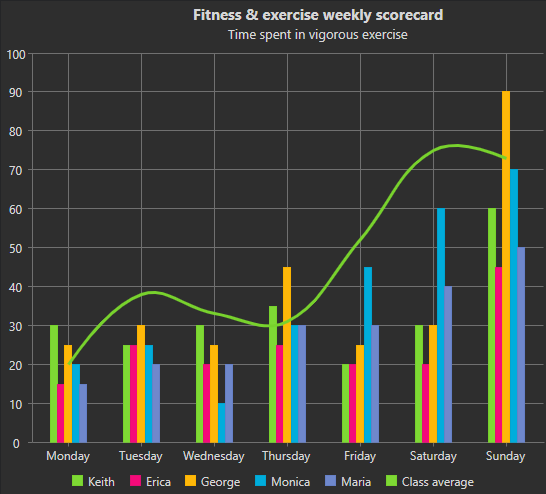
Demo source (Smart UI repo): angular/src/chart/overview
1 NPM Install
Install the smart-webcomponents-angular package:
npm install smart-webcomponents-angular
2 Register styles
Add the default Smart UI stylesheet to angular.json -> projects -> <your-project> -> architect -> build -> options -> styles (merge with existing entries):
"styles": [
		"node_modules/smart-webcomponents-angular/source/styles/smart.default.css"
	]
Add optional theme CSS from the same package after smart.default.css if you use Bootstrap, Fluent, or other bundled themes.
3 Import the Angular module
Import ChartModule from smart-webcomponents-angular/chart: use @Component.imports for standalone, or add it to your AppModule (or feature module) imports array for NgModule apps.
import { ChartModule } from 'smart-webcomponents-angular/chart';
4 Root component (standalone)
Add ChartModule to your root standalone component (src/app/app.ts). Snippet from Smart UI demos (paths normalized to app.html / App where applicable):
 import { Component, ViewChild, OnInit, AfterViewInit } from '@angular/core';
import { ChartComponent } from 'smart-webcomponents-angular/chart';

import { ChartModule } from 'smart-webcomponents-angular/chart';

@Component({
  selector: 'app-root',
  standalone: true,
  imports: [ ChartModule ],
  templateUrl: './app.html',
  styleUrl: './app.css'
})

export class App implements AfterViewInit, OnInit {
	@ViewChild('chart', { read: ChartComponent, static: false }) chart!: ChartComponent;

	 caption = "Fitness & exercise weekly scorecard";
	 description = "Time spent in vigorous exercise by activity";
	 showLegend = true;
	 padding = { left: 10, top: 10, right: 15, bottom: 10 };
	 titlePadding = { left: 90, top: 0, right: 0, bottom: 10 };
	 dataSource = [
		{ Day: 'Monday', Running: 30, Swimming: 10, Cycling: 25, Goal: 40 },
		{ Day: 'Tuesday', Running: 25, Swimming: 15, Cycling: 10, Goal: 50 },
		{ Day: 'Wednesday', Running: 30, Swimming: 10, Cycling: 25, Goal: 60 },
		{ Day: 'Thursday', Running: 40, Swimming: 20, Cycling: 25, Goal: 40 },
		{ Day: 'Friday', Running: 45, Swimming: 20, Cycling: 25, Goal: 50 },
		{ Day: 'Saturday', Running: 30, Swimming: 20, Cycling: 30, Goal: 60 },
		{ Day: 'Sunday', Running: 20, Swimming: 30, Cycling: 10, Goal: 90 }
	];
	 colorScheme = 'scheme13';
	 xAxis = {
		dataField: 'Day',
		unitInterval: 2,
		tickMarks: { visible: true, unitInterval: 1 },
		gridLines: { visible: true, unitInterval: 1 },
		valuesOnTicks: false,
		padding: { bottom: 10 }
	};
	 valueAxis = {
		unitInterval: 10,
		minValue: 0,
		maxValue: 50,
		title: { text: 'Time in minutes<br><br>' },
		labels: { horizontalAlignment: 'right' }
	};
	 seriesGroups = [
		{
			type: 'spline',
			series: [
				{
					dataField: 'Swimming',
					symbolType: 'square',
					labels: {
						visible: true,
						backgroundColor: '#FEFEFE',
						backgroundOpacity: 0.2,
						borderColor: '#7FC4EF',
						borderOpacity: 0.7,
						padding: { left: 5, right: 5, top: 0, bottom: 0 }
					}
				},
				{
					dataField: 'Running',
					symbolType: 'square',
					labels: {
						visible: true,
						backgroundColor: '#FEFEFE',
						backgroundOpacity: 0.2,
						borderColor: '#7FC4EF',
						borderOpacity: 0.7,
						padding: { left: 5, right: 5, top: 0, bottom: 0 }
					}
				}
			]
		}
	]

	ngOnInit(): void {
		// onInit code.
	}

	ngAfterViewInit(): void {
	 }
}
Boot the app with bootstrapApplication from src/main.ts and an ApplicationConfig in src/app/app.config.ts as generated by the CLI.
5 Template (standalone)
Use your markup in src/app/app.html (or inline template). Bind properties and events on smart-chart as needed:
 <smart-chart #chart id="chart" [caption]="caption" [description]="description" [showLegend]="showLegend"
    [padding]="padding" [titlePadding]="titlePadding" [dataSource]="dataSource" [colorScheme]="colorScheme"
    [xAxis]="xAxis" [valueAxis]="valueAxis" [seriesGroups]="seriesGroups"></smart-chart>
6 NgModule bootstrap (also supported)
Same npm package and angular.json styles as steps 1-2. Put ChartModule on your NgModule.imports instead of @Component.imports, and bootstrap with bootstrapModule(AppModule).
The demo sources bundled for this widget use standalone only (there is no app.module.ts in that folder). NgModule is fully supported: put ChartModule from smart-webcomponents-angular/chart on NgModule.imports, make your root component non-standalone (remove standalone: true and move widget modules from @Component.imports to the module), and bootstrap with platformBrowserDynamic().bootstrapModule(AppModule).
Minimal main.ts + app.module.ts pairing (adjust paths to match your CLI layout):
src/main.ts
import { platformBrowserDynamic } from '@angular/platform-browser-dynamic';
import { AppModule } from './app/app.module';

platformBrowserDynamic().bootstrapModule(AppModule).catch((err) => console.error(err));
src/app/app.module.ts
import { NgModule } from '@angular/core';
import { BrowserModule } from '@angular/platform-browser';
import { AppComponent } from './app.component';
import { ChartModule } from 'smart-webcomponents-angular/chart';

@NgModule({
	declarations: [ AppComponent ],
	imports: [ BrowserModule, ChartModule ],
	bootstrap: [ AppComponent ]
})
export class AppModule { }
Reuse the template and class logic from steps 4-5 in AppComponent, configured for declarations + NgModule.imports instead of a standalone @Component.
Run
ng serve or npm start - then open http://localhost:4200/.
Smart UI for Angular - full documentation
Common Use Cases
-
Update chart data dynamically
Refresh chart with new data points
chart.dataSource = newDataArray;
chart.refresh();
-
Change chart type
Switch between chart types like line, bar, pie
chart.seriesGroups[0].type = 'column';
chart.refresh();
-
Export chart as image
Save the chart as a PNG or JPEG file
chart.saveAsImage('chart.png', 'image/png');
Troubleshooting
- Why is my chart blank?
- Verify dataSource contains data and seriesGroups are configured with valid dataField references matching your data keys.
- How do I update chart data dynamically?
- Reassign the dataSource property and call chart.refresh() to redraw with new data.
- How do I change the chart colors?
- Set the colorScheme property (e.g., 'scheme01' to 'scheme32') or define custom colors in seriesGroups series configuration.
Accessibility
The Chart component follows WAI-ARIA best practices:
- Keyboard navigation - Tab, Arrow keys, Enter, and Escape are supported
- ARIA roles - Appropriate roles and labels are applied automatically
- Focus management - Visible focus indicators for keyboard users
- Screen readers - State changes are announced to assistive technology
- High contrast - Supports Windows High Contrast Mode and forced colors
For custom labeling, set aria-label or aria-labelledby attributes on the component.
Supported stacks: Smart UI targets Angular 17+, React 18+, Vue 3+, Node 18 LTS, and evergreen browsers; pin exact package versions to your org policy.